
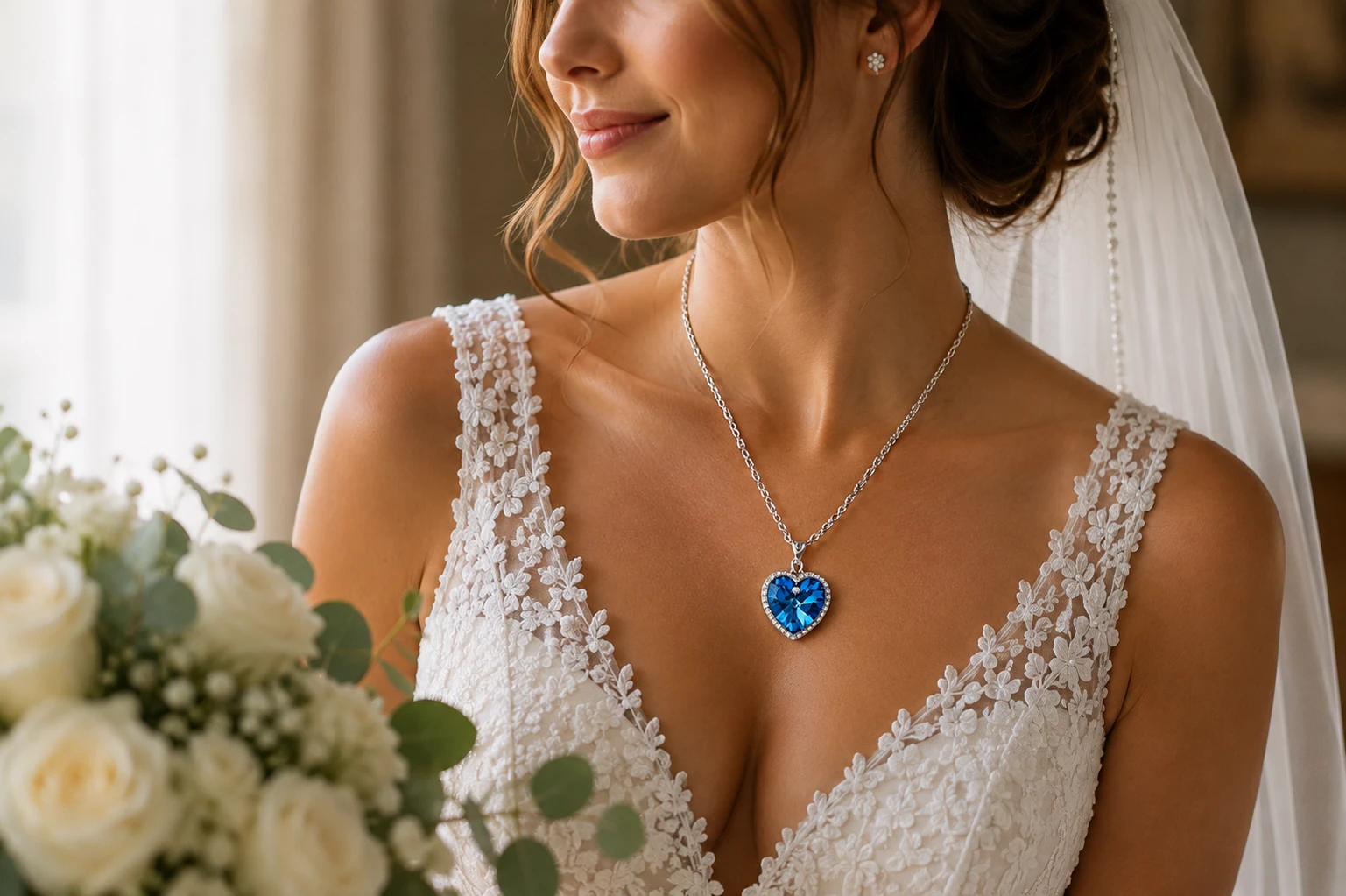
A Blue Heart Necklace: A Romantic Take on Something Blue
“Something old, something new, something borrowed, something blue” is one of those wedding traditions that leaves plenty of room for interpretation. Some brides sew a tiny blue ribbon into the lining of their dress. Others choose blue shoes, flowers or a discreet detail hidden in the bouquet.
A piece of jewellery offers another possibility. It can be visible during the ceremony, appear naturally in photographs and remain meaningful long after the wedding day has passed.
A blue heart necklace is particularly well suited to this role. The colour fulfils the tradition, while the heart adds an unmistakably romantic element. Unlike a temporary accessory, it can later be worn for anniversaries, dinners or any occasion connected with the memories of the day.
Why choose jewellery for something blue?
Wedding traditions often work best when they feel personal rather than obligatory. A bride may love the idea of something blue but struggle to find a detail that fits naturally with her dress and the overall mood of the ceremony.
Jewellery solves that problem in a practical way. A necklace does not need to match the flowers perfectly or become part of the venue decoration. It simply sits close to the wearer and becomes part of her own bridal look.
There is also something lasting about choosing a jewel. Flowers fade, table decorations are packed away and even the wedding dress may spend most of its life carefully stored. A necklace is easier to bring back into everyday life.
Years later, wearing it again may recall the quiet moments before the ceremony, the first photographs or the feeling of walking into the room and seeing everyone gathered together.
The symbolism of a blue heart
Blue has long been associated with loyalty, calm and trust. Those qualities make it a natural choice for a wedding, even without the familiar rhyme.
The heart shape adds a second layer of meaning. It is direct without needing an inscription, initials or a wedding date. Whether the necklace is chosen by the bride or given by someone close to her, its message is easy to understand.
A deep blue stone also has a visual presence that softer bridal colours sometimes lack. Ivory, white and champagne fabrics create an elegant foundation, but a small area of intense colour can make the whole look more memorable.
The effect does not need to be loud. When the pendant is positioned correctly, the blue appears as a deliberate focal point rather than a competing colour.
Matching the necklace to the dress neckline
The neckline of the dress should guide the choice and placement of the necklace. It determines how much space is available and where the pendant will sit in relation to the fabric.
V-neck dresses
A heart-shaped pendant works naturally with a V-neck because both shapes direct the eye towards the centre. The pendant should sit within the open area of the neckline rather than touch the edge of the dress.
This pairing creates a balanced look and usually allows the necklace to remain clearly visible in both close-up and full-length photographs.
Sweetheart necklines
A sweetheart neckline already echoes the outline of a heart. Adding a heart pendant can reinforce that romantic shape, but scale matters. A pendant with a clear central stone and a refined setting will usually work better than an excessively wide or heavy design.
Leaving a little space between the necklace and the dress prevents the two heart shapes from appearing crowded.
Strapless dresses
A strapless gown offers a generous open area for jewellery. This gives a blue pendant room to become the main detail near the face.
With this style, earrings should remain relatively restrained. Otherwise, the necklace, earrings and neckline may all compete for attention.
High or heavily detailed necklines
A dress with lace extending towards the neck, dense beading or a high collar may not need a necklace at all. In that case, the blue detail could be introduced through earrings, a bracelet or another bridal accessory.
The tradition should adapt to the dress, not force the bride to wear jewellery in a space that is already visually complete.
How much blue is enough?
It can be tempting to repeat the same shade throughout the bridal look: blue pendant, blue earrings, blue shoes, blue flowers and even blue hair accessories. The result may feel more coordinated than personal.
In most cases, one or two blue elements are enough. A pendant can stand alone, or it can be paired with a very small matching detail elsewhere.
The shades do not need to be identical. A deep blue crystal can work beautifully with pale blue flowers or a soft ribbon because the difference in intensity creates depth. Trying to match every element exactly may make the styling feel overly planned.
Silver-toned or bright white settings tend to sit naturally with cool blue stones and white bridal fabrics. Warmer ivory gowns can also work, especially when the contrast is intentional.
A gift before the ceremony
A something-blue necklace does not have to be selected by the bride herself. It can become a thoughtful gift from her partner, a parent, a sibling or a close friend.
The timing of the gift can make it even more meaningful. Some families exchange small presents during the wedding morning, once the dress is on but before the ceremony begins. Others give jewellery at the rehearsal dinner or during a quieter moment a few days earlier.
A necklace presented in its own box also creates a natural photographic moment. It can be captured beside the rings, invitation suite, perfume or other personal details before it is worn.
For someone drawn to romantic jewellery and cinematic love stories, a romantic blue heart necklace from Heart of the Ocean can bring together the something-blue tradition with a design that already carries a strong emotional identity.
The gift still needs to suit the person receiving it. The most successful choice will feel connected to her taste, her memories or the story shared by the couple, rather than being selected only because the stone happens to be blue.
Keeping the rest of the jewellery balanced
A blue heart pendant is already a recognisable feature, so the surrounding jewellery does not need to be elaborate.
Small clear studs, pearl earrings or delicate silver-toned drops will support the necklace without drawing attention away from it. Large blue earrings can work, but they create a more dramatic and coordinated result.
The same principle applies to bracelets and rings. Bridal styling often becomes more elegant when each piece has a clear role. The wedding rings naturally receive attention, while the necklace brings colour and detail closer to the face.
Mixing metals is possible, although a consistent finish usually looks calmer in photographs. A bride wearing predominantly silver-toned jewellery may prefer the necklace setting and other accessories to follow the same direction.
Thinking about the photographs
Wedding jewellery is seen in person, but it also becomes part of the photographic record of the day. A blue pendant can be particularly effective because it remains visible against light fabric and skin tones.
Before the wedding, it is worth trying the complete look in natural light. The necklace may sit differently once the dress, undergarments and final hairstyle are in place.
Take a few photographs from different distances. A pendant that appears perfectly proportioned in the mirror may look smaller or larger in a full-length image. This simple test also shows whether the chain twists, whether the heart remains centred and whether the neckline leaves enough space around it.
If the bride plans to wear her hair down, she should also check that it does not constantly cover the necklace. Soft waves can frame a pendant beautifully, but the chain should remain comfortable and free from tangling.
Wearing it after the wedding
One advantage of choosing jewellery as something blue is that its meaning can continue to evolve.
After the ceremony, the necklace may be worn on the first anniversary, during a honeymoon dinner or at another wedding-related celebration. It may also become part of ordinary life, paired with a white shirt, a black dress or a simple knit.
That does not diminish its sentimental value. In fact, using the necklace again may prevent it from becoming an object that is remembered fondly but rarely seen.
Some brides prefer to preserve every wedding accessory untouched. Others enjoy allowing those pieces to collect new memories. There is no correct approach. The value lies in the connection the necklace retains with the original moment.
A small tradition with a lasting place
Something blue does not need to dominate the wedding look. Its charm often comes from being a carefully chosen detail: noticeable to the bride, meaningful to the people closest to her and quietly present throughout the day.
A blue heart necklace brings colour, romance and permanence to the tradition. It can complement the dress during the ceremony, appear in the photographs and later return as a wearable reminder of the celebration.
Long after the bouquet has been dried and the dress has been stored away, the necklace can still be opened, worn and remembered. That is what makes jewellery such a natural interpretation of something blue: the tradition lasts for a day, but the object can carry the story much further.